


As China prepares to transfer its leadership in March, the potential exists for a more progressive government. With asset-based policies increasing throughout Asia in response to rising inequality and aging populations, there has never been a better time for discussion.
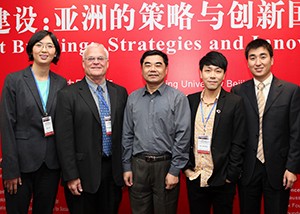
This past November, the Center for Social Development (CSD) at the Brown School at Washington University in St. Louis partnered with Peking University and Hong Kong Polytechnic University to host the conference “Lifelong Asset Building: Strategies and Innovations in Asia” at Peking University in Beijing.
“The conference enabled stakeholders in the Asia Pacific region to share knowledge and lessons and build a network of policy makers and professionals advancing asset building in Asia and beyond,” says Li Zou, CSD international director.
Topics at the conference, which drew about 100 participants from China and around the world, included national policies, home ownership, savings for children and youth, social entrepreneurship, asset-building innovations and policy diffusion.
“Washington University in St. Louis is proud to partner with Peking University, Hong Kong Polytechnic University, National University of Singapore and others in organizing this conference,” says James Wertsch, PhD, vice chancellor for international affairs and the Marshall S. Snow Professor in Arts & Sciences. “With aging populations in many countries, building assets over the life course will be fundamental for both economic development and security in old age.”
The Nov. 16-18 conference garnered extensive media coverage in China, including articles in high-profile news outlets such as China Youth Daily, Sina News, China Daily, ifeng.com and NetEase (163.com). Peking University News wrote an extended story, and China Social Sciences published a long story about the conference on its front page. The media coverage has helped spread news of this topic to wider audiences, expanding the conversation about asset-building innovations.
Michael Sherraden, PhD, director of the CSD and the Benjamin E. Youngdahl Professor of Social Development at the Brown School, says that several countries in Asia have created innovative policies and programs that build assets for family and community development.
“All of this experience can inform innovations in the United States and elsewhere,” Sherraden says. “It is possible that inclusive and progressive asset-based policies may play a larger role in many countries in the years ahead.”
To read more about the conference, visit csd.wustl.edu/AboutUs/News/Pages/Asset-Building-in-Asia.aspx.