
WUSTL

Cameras in CWE and on Medical Campus among new security steps taken

By Elizabethe Holland Durando
Robert Boston

Two Barnes-Jewish Hospital security guards patrol the Washington University Medical Center campus. Additional bike patrols are one of several steps taken in recent years to augment security on the medical center campus.

As springtime spurs Washington University Medical Center students and employees to spend time outdoors for strolls across campus or lunch in nearby restaurants, they’ll do so under the protective watch of newly affixed security cameras at campus and neighborhood street corners.

The installation of 91 such cameras — 60 of which will be paid for by the medical center — began in the fall and will continue over the next couple of months at corners and other sites throughout most of the Central West End (CWE). An additional 42 such cameras will be installed throughout the Medical Campus. The cameras augment ongoing efforts by the medical center to heighten safety for employees, students and also area neighborhoods.

The CWE cameras already have been instrumental in providing evidence for police in a handful of incidents since the new year began, says Jim Whyte, executive director of the CWE Neighborhood Security Initiative (CWE NSI), a partnership between the medical center and the CWE’s special business districts.
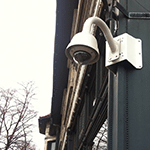
 
“In a very short period of time, the neighborhood security cameras have proven to be effective in creating a safer environment,” Whyte says. “We expect them to not only help us build cases against those who break the law, but to discourage criminals from coming here in the first place.”

WUMC will provide funding for monitoring of the CWE cameras. Further, the medical center is funding a court advocate, who will follow criminal cases from start to finish. The advocate, former police officer Isabella Lovadina, will report outcomes to community members and ensure that those affected by area crime have an opportunity to communicate their wishes and concerns to the court system.

The investments are the latest in a series of efforts by the medical center over several years to bolster safety on the Medical Campus and in the communities it borders. The medical center consists of Washington University School of Medicine, Barnes-Jewish Hospital, St. Louis Children’s Hospital and BJC HealthCare.

“We are committed to making our environment as safe as possible,” says Rick Stanton, the School of Medicine’s vice chancellor of administration and finance. “The security of our patients, students, faculty, staff, visitors and neighbors has always been a priority for the medical school and our affiliated hospitals.”

Brooks Goedeker, community development manager and board president of the CWE NSI, says that safety-related efforts by WUMC have had a significant impact on criminal activity. Since 2005, overall crime is down by 60 percent and crime against persons by 40 percent in the CWE, he notes.

Says John Ursch, director of Protective Services for the medical school: “Eradicating crime is a challenge anywhere, and we encourage students, employees and area residents to always remain vigilant. But we are intent on making criminals feel unwelcome here, and we are having a very real impact that we will continue to build upon.”

The medical center’s efforts include:
• Around-the-clock staffing of more than 200 trained security officers in vehicles, on foot and on bikes. More bike patrols have been added this winter.
• Networks of more than 700 security cameras between the school and hospitals.
• A push for neighborhood orders of protection, to encourage known criminals to stay away.
• An $8 million investment in 2009 and 2010 to increase street lighting in all areas serving the medical center.
• A leading role in the creation of special taxing districts in area neighborhoods and the pulling together of those special districts to form the CWE NSI. The medical center has contributed more than $2 million since 2000 to help fund security initiatives in those neighborhoods.
• Shuttle buses and security escorts for transportation to parking lots and nearby neighborhoods. In 2012 alone, the center provided more than 10,000 escorts. Recently, the medical center expanded such services; it now offers students and employees free transportation to their homes in the DeBaliviere Place and Skinker/DeBaliviere/Parkview neighborhoods.

For details on shuttle buses and security escorts, follow this link. 

For information about Protective Services, follow this link.