


Chinese President Hu Jintao’s visit to the U.S. in early September comes amid strains between the two countries over such economic issues as the ballooning U.S. trade deficit with China, a failed bid by China’s Cnooc Ltd. to buy U.S. oil-and-gas company Unocal Corp., and China’s longstanding and widespread violation of intellectual property rights (IPR).
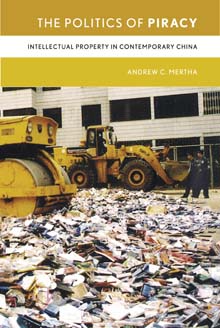
Although large, international companies may be more comfortable fighting these abuses at the national level, Mertha’s analysis shows that efforts to protect intellectual property are much more successful when pressure is exerted from within China. He notes, for instance, that foreign companies have achieved much greater trademark protection by using private investigative agencies to exert continuous pressure from within the communities where flagrant violators operate, sometimes going so far as to subsidize the limited budgets of local anti-counterfeiting agencies.
In his book, Mertha traces the history, cultural context and ongoing economic implications of intellectual property in China, detailing subtle but important nuances that help determine who in China really has the power to help companies successfully protect their brands, copyrights and trademarks.
From among the many dimensions of Chinese intellectual property explored in his book, Mertha offers the following summaries of three areas he considers to be the most important and least understood.
First, many people argue that China should utilize its IPR provisions within the revised criminal law to go after the pirates and counterfeiters. This is a sound strategy, but one that will take many years to show results. At present, we must acknowledge that in the short-to-medium term, China’s legal infrastructure does not have the capacity or the authority to effectively handle the sheer volume of potential IPR violations. The courts are under the jurisdiction of local governments, which sometimes have a direct interest in looking the other way when it comes to IPR violations. In some cases, the violating factories are owned by the local governments in question. More often, however, local governments want to ensure social stability and this means employing as many people as possible, even if it means employing them in IPR-violating enterprises.
Second, like most Chinese right holders, we should look to China’s extensive administrative enforcement bureaucracies for help. But to do so effectively, it is necessary to identify shortcomings within these institutions and to be creative in finding ways to compensate for them. For example, China’s copyright enforcement apparatus is extremely weak in terms of its personnel, operating budget, and bureaucratic reach. Many Chinese copyright holders recognize this and have chosen to protect their rights by taking their claims to the far more powerful trademark and anti-counterfeiting bureaucracies by invoking laws on trademark, anti-unfair competition, and product quality.
Third, we need to recognize that intellectual property violations are based, first and foremost, on economic, not legal or “cultural,” calculations. Most Chinese (and expatriates in China) buy pirated software, motion pictures, and music CDs because they are cheaper by several orders of magnitude than their legitimate counterparts. Microsoft Office costs more in China than it does in the United States, about the monthly income of most middle-class Chinese. It is no wonder, therefore, that the Chinese prefer to buy it for a dollar. By bringing the price closer to the black market price, at least temporarily, US companies can use their comparative advantage of virus-free software, product upgrades, and support services. This may mean losing money in the short run, but in the long run these losses pale in comparison to the continuation of the status quo.
“Intellectual property in China is a highly sensitive and often misunderstood policy issue,” Mertha concludes. “It is embedded in a complicated institutional context, one in which change is often swift and dramatic — and uneven — and its future trajectory remains largely uncertain. If we want to curtail piracy and counterfeiting in China, we must learn the lessons of past engagement with China over the issue as well as take into account some of the basic factors of IPR violations in China that never seem to make it onto the public — and often, private — discourse over the issue. Ultimately, to be effective, we must find some way to work with national-level Chinese authorities, to help them implement laws already on the books and enforce them at the local level.”
Editor’s Note: To request a complimentary copy of the book for review consideration in your publication, please contact Heidi Lovette, 607-277-2338 x230 or HSL22@cornell.edu.